
I know it seems like it’s been crickets over here…

…BUT the property has been unseasonably wet. Instead of heading to the land every weekend or so to do some work, we’ve been heading there every few days just to check the rain gauge and see the progress on the pond-filling front. In the month of July, we dumped a whopping 12 inches of rain from our rain gauge, which was a record-setting month for Iowa.
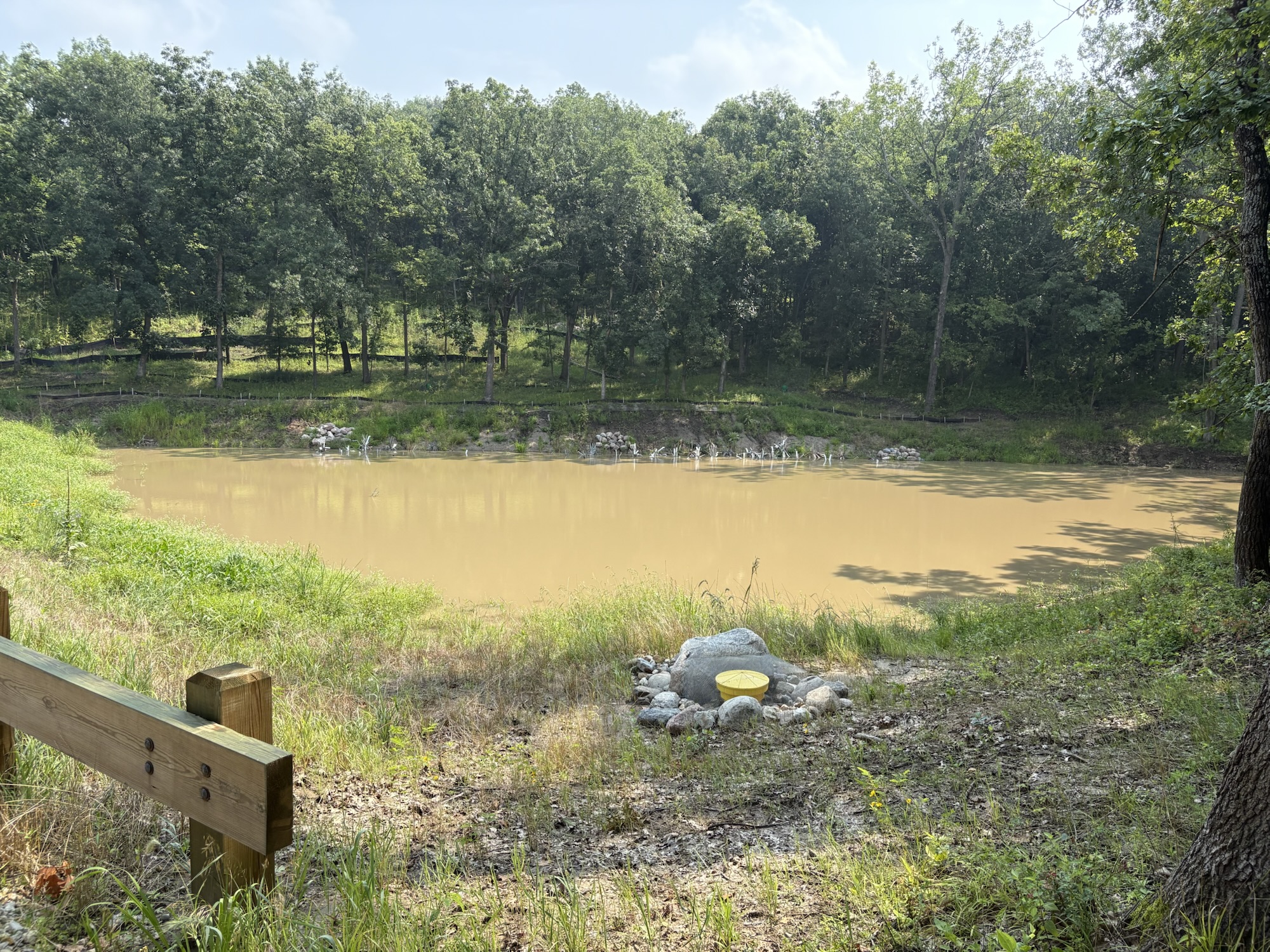
Our pond began the month looking like this:

It ended the month looking like this:

We estimate it came up about two and a half feet during that span, which is considerable progress given the extreme heat we were experiencing at the same time; additionally, the surrounding ground at that level needed to reach a certain saturation point before it could really hold water. We realized that although the first foot or two of top soil had remained consistently hydrated (which the trees and prairie were loving), the degree of ground saturation at that six to nine foot depth had been very little.
Initially, the pond seemed quick to fill; with every rain came noticeable rise. While that can be attributed—in large part—to the relatively small surface area at the deepest depths, it’s also within reason to give some credit the fact that the surrounding ground at those depths had been quite accustomed to being submerged under water and had retained significant saturation down deep. The mid-range depths weren’t that way; the water level was now above the point at which the pre-rehabbed pond had sat for decades, so it was understandable when the fill rate began to slow and the water level started to ebb and flow more than it had at the beginning.
If it was possible to will a pond full, trust me, ours would’ve been full many times over. I’d also be lying if I said we didn’t contact our pond whisperer, concerned after a major stall in mid-June when several rainstorms—totaling nearly three inches of rain—failed to move the needle at all. We were reassured that the level could fluctuate and with the amount of bentonite that was used in the rehab, we should have little to be concerned about. And of course, true to form, he was right.
That wet July gave us hope that we would eventually see the pond reach its anticipated full mark, even if just inch by painstaking inch. We also began to reflect back on the prior year; it was difficult to believe it had already been a full year since our repaired pond was capable of collecting water again.


If you’re anything like me, you’re often up in the middle of the night calculating volumes of inverted cones. I’m guessing that isn’t relatable for most of you, so I’ll spare you all the formulas and give you the gist. Think about those cone-shaped, paper water cups; if you fill one about 80% of the way up (height/depth), it’s only holding about 50% of its capacity by volume. So, if we estimate our pond is about 70-80% full by depth, then a year in, we only have half the water we’re going to need in there to fill it.
That record-setting foot of rain in July left the pond about 16-17 feet deep, but the last 5-6 feet may take a while. Using aerial maps and a whole host of calculations, I’ve estimated that our finished, full pond will be just over 1/3 of an acre in surface area with an average depth of 9 feet. That works out to roughly 3 acre-feet of water, or about 1,000,000 gallons. Half a million gallons down, half a million to go.
When a pond is half full, you can start doing cool things—like think about stocking it with lots of scaly friends. Also, the water level is getting closer and closer to the vegetated banks, so we can begin preparing for water quality interventions—like clearing the water by using a flocculent to knock the suspended clay particles down and then using a dye to help block light, keeping the water cooler and algae growth to a minimum. We also need to consider aeration, but we’ll include you in all that when we get there.
Here’s a progress look at the banks we seeded with my custom water’s edge prairie mix over the winter.


In the meantime, we’ve just recently embarked upon a new project—rather unexpectedly, no less.
For the first time in I-don’t-know-how-long, we had a free weekend, and the weather was nice. And it wasn’t just nice, it was really nice. Low 52, high 78, hadn’t rained for three or four days, and wouldn’t rain again for about a week. We had already planned to go to the property to work on stuff, but given that window of weather, we had to jump on one project in particular.
You guessed it: staining the guardrail. We had the guardrail installed in mid-October last year. Shortly thereafter, I researched what felt like a million different stains and sealers to help us protect our investment. I quickly settled on a stain with Brazilian rosewood oil, specifically intended for use on pressure treated wood. The brand? Penofin. The reviews were superb, the photos and videos were gorgeous, the product touts 99% UV blocking and the ability to lock in carcinogens from pressure treated wood, and I knew that was the one.
I spent a couple nights calculating the surface area of all the lumber that was used for the guardrail and cross-referenced the coverage rates of the product; I estimated eight, one-gallon cans would be a good start and placed the order. After that, the eight cans of Penofin sat in our building, waiting for the right weather conditions and our availability to simultaneously line up. In order to apply the stain, the outdoor temperature had to be between 45 and 80 degrees, the wood had to be dry, and it couldn’t rain for at least 24 hours afterward, preferably longer. Additionally, we had to be available too. Yeah right!
All those conditions didn’t coincide until nearly ten months later, so we pounced. I mean, it really felt like a “now or never” moment, so that was the mentality going in. We invited our moms, because the four of us have tackled some pretty impressive projects together. We started with open minds and zero expectations. The stain was about the consistency of water; we timidly began and applied gingerly, but we quickly learned how forgiving this stuff was. The wood soaked it all up instantly. It didn’t matter if you dabbed, swirled, went with the grain, or against the grain; it looked amazing. We quickly fell into a routine, became more confident, and zipped through the whole east side rail in about three and a half hours.

For this operation, we had three of us staining at once; two people were on the backside of the rail where the posts are, and one was on the inside of the rail where the driveway is. The fourth was the gopher: move the towels, get more stain or gloves, and fetch hydration. The gopher was also the wiper; the untreated lumber needed a quick wipe to get rid of dirt and bird droppings before the stain was applied. Additionally, 20-30 minutes after applying the stain, every surface had to be wiped down with a cotton cloth (old t-shirt in our case) to remove any excess stain. If excess is allowed to dry, it could become sticky/tacky, so we followed the application instructions to the letter. We established a good pattern with timers and markers for wiping sections down within the right timeframe. The gopher had a tough job; at one point, while wiping down an untreated post, the gopher unknowingly stuck his hand in an inhabited wasp’s nest and was stung on the hip. Sorry Hun!
After completing the first run of guardrail on the east side, we took a nice break to hydrate, stretch, and admire our work. Then we made the fateful decision to take on the west guardrail. By that time, it was midday, and we were in full sun. The gopher fetched an old tailgating tent to keep a couple sections shaded at a time, which we moved along the rail with us.

About halfway through the west run of railing, our pace started to slow. We were needing more frequent breaks and more sustenance. Our bodies were feeling it; backs, ankles, feet, butts, groins—you name it, it hurt. This is the point at which we all began contemplating (if not out loud, then definitely in our heads) calling it, but this determined bunch soldiered through, figuring we’ve come too close to the end to not finish. We completed the entire lengths of guardrail on both sides of the dam. Nobody would’ve have ever thought that was possible, but we did it.
How much stain did it take? 7.75 gallons! We couldn’t believe it; the eight cans I ordered was the perfect amount. How many vertical posts did we do? 67. Yes, 67. How long is the guardrail? The east run is 177 feet long. The west run is 219 feet long. The total length of the guardrails is 396 feet!

In retrospect, it was probably the extra 42 feet on the second side that nearly killed us. I kinda still can’t believe we finished it, much less in just one day and without needing any more stain. It really couldn’t have worked out any better. Big, big thanks to our moms—they were the shining stars that day, no doubt. Now that’s finally a project we can cross off the list! Stay tuned for more; trust me, there will always be more.
**Update**
We have an, um, interesting development that’s definitely addendum-worthy. A couple freak rainstorms in early August yielded 4.7 inches of rain within 24 hours. Two days later, it’s still draining out of the sediment basin (which had been completely overtaken during these storms).

With the ground already saturated, nearly all of the 4.7” was runoff. We estimate these storms brought us up two to three more feet, which leaves us only another 2-3 feet to go until full.


The last couple/few feet are gonna be AWESOME. We can’t wait!
Leave a Reply