
We are learning a lot through research and others’ experiences, but we’re also learning through our own trial-and-error. We have even pushed the boundaries on more than a few occasions. So for fun, we’ve decided to share some of those boundary pushing experiences.
We want to preface this by saying that we work in healthcare, but our background is in academia. Safety is always our top priority. And yes, kids, physics is very, very useful in everyday life.
When we first began working on the property, we had to hike in from the road and haul all our gear up and down the hill with us every time. After awhile, we had accumulated enough supplies to warrant a less labor-intensive strategy; of course, the solution was quite labor-intensive itself. We manually hauled up a wooden pallet, a long log chain, and the pieces of a Rubbermaid storage shed one by painstaking one. We built the shed on site and chained it to a tree with a padlock; that’s where we stored most of our equipment for the two years before building our Morton.

Once our building was completed, it was time to unchain our temporary shed and move it and all its contents indoors. Once emptied, it was still surprisingly large and heavy, making it very awkward to maneuver across uneven terrain, through trees, and down the hill to the building. That’s when we paused to think. We definitely weren’t going to disassemble and reassemble that thing. I always preach to our son to work smarter, not harder, so I had to take my own advice. Here’s what I came up with:

The transport took less than two minutes with minimal effort. Success! In its current location, we’ve repurposed it to store our long-handled gardening tools.
The next task was to empty out our storage locker. Finally having our own building, we no longer needed to rent space to store all our salvaged doors and other treasures. Since 2017, a nearby storage locker was home to an ever-growing hoard, albeit an organized one. More than five years later, we were able to transport most of its contents using just our truck and SUVs.
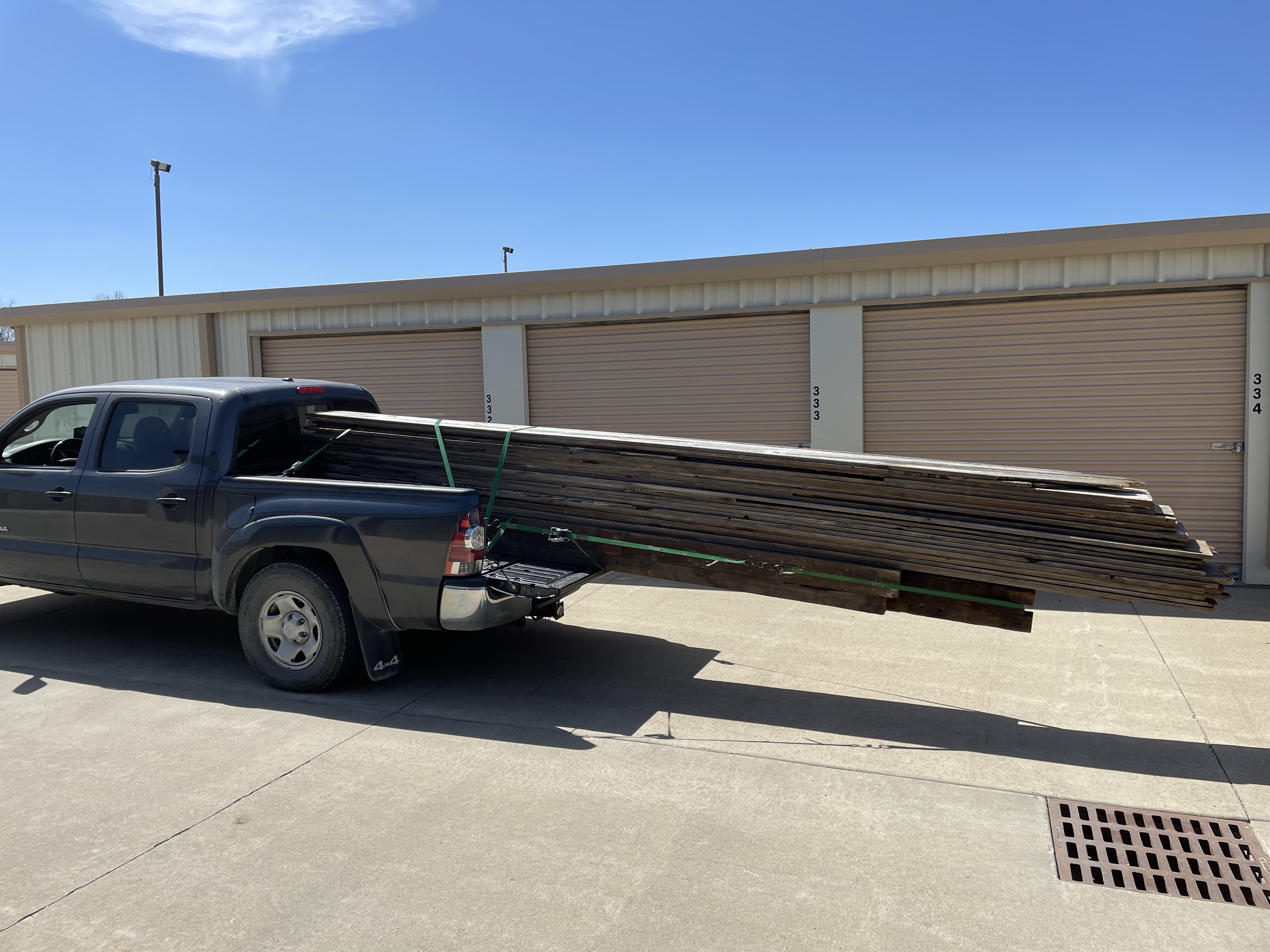
A few large pieces remained, including the largest doors and tracks. We wanted to avoid the number of trips requiring a trailer because of the steep and winding nature of the driveway to our Morton. I figured out we could get all the remaining locker contents in one trailer load IF we could transport our barn wood with our truck. That was a big IF. Our truck bed is short (6’8” with the tailgate down) and the barn beams and siding were long (13-16’), but I took physics in college, so I devised a plan. I drew pictures, explained, and garnered a little support.
On moving day, however, my plan was met with so much skepticism and head-scratching, it almost wasn’t even attempted.

We took our heavy, solid, 13- and 14-foot long barn beams with grooved ends and strapped them straight in toward the cab. Then, we stacked the 16-foot long, flexible barn siding on top, strapping those straight down to the truck bed.

To this day, our families are shocked that it worked. Granted, we only had to make it a couple miles, but we’re very proud of that well thought out, seemingly harebrained plan. For the next one, we have to back up in time a little.
After the building site was cleared and before the building materials were delivered, we identified a few thorny honey locust trees along the edge of the new tree line. Two of them in particular would end up directly across from one of the large, overhead garage doors of the building. We wanted to eliminate those thorny honey locust trees and utilize the space to give us a wide berth opposite the overhead door.

Of course, felling those trees would be exponentially easier to do if we could drop them into the clearing before the building went up as opposed to attempting to down them without hitting the building or having them get hung up in other trees. In our haste to eliminate those nuisance trees before the building was delivered, we unknowingly got ourselves in a bit of a pickle. One of the trees had a low hanging limb which we removed first. It wasn’t until later we realized leaving that limb would’ve provided the needed weight for it to naturally want to fall into the clearing.
We made a perfect hinge, but as we began the felling cut, we realized the tree was then going to want to fall backwards into the other trees instead of forward into the clearing. By the time we got out our splitting wedges, the felling cut had already closed. Had we left that first limb on the tree, the weight would’ve pulled it in the right direction, but now that we were in this conundrum, we had to figure out how to get ourselves out of it. I decided we could use this large building-free clearing to our advantage and pull the tree down in the direction we wanted it to go. I knew we had enough room to stay at a safe distance, so we rigged winches around the tree and attached them to the frame of the truck.

Problem solved. That area is now the perfect turnabout outside of the Morton overhead door.

While the solution worked, it’s not a tactic we’ll want—or even be able—to use in the future; we now think twice before taking limbs off first. We hope we don’t accumulate too many more of these experiences, but we’ll continue to share all our fun along the way.
Leave a Reply