
We’ve been working on a lot of odds and ends, and it was only recently I thought we’d done enough to be post-worthy.
As if we don’t have enough trees, we started to think we needed more. Maybe it was the fact that we’d still been working our way through the piles of downed trees our driveway and Morton had left in their wake that made us yearn for more trees or maybe it was the little barren spots here and there along the driveway that simply looked like something belonged there.
Just as with most goals on the homestead, we want at least dual purposes to all the interventions we embark upon. Therefore, when deciding what kind of trees to plant, we ended up choosing sugar maples. While they’ll provide a multitude of gorgeous fall colors along our driveway, they’ll also be a means through which our son can make his own maple syrup one day.
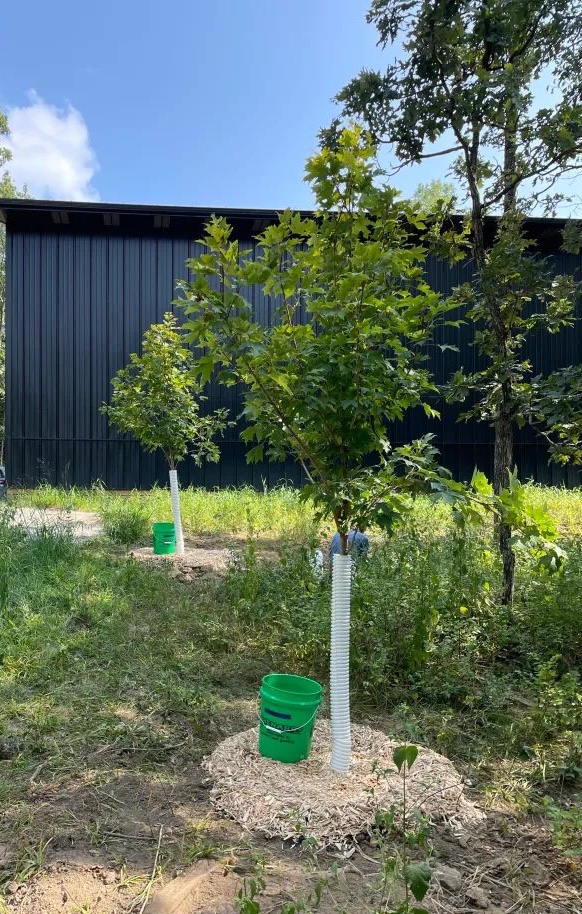
We went to a local nursery and picked out two sugar maples to start this next phase of our homestead. While we were there, the most wonderful employee directed us to their clearance rows. Housed in this section were perfectly good specimens that either had a bow in their trunks (which they would eventually grow out of) or were simply too large for their pots and needed to be planted. Best of all, they were about one-third the price. We picked out a third sugar maple and we also added an enormous Autumn Blaze Maple that we simply couldn’t resist.

Off we went to plant our four new maple trees. True to form, much research ensued about different planting techniques, locations, spacing, soil conditions, you name it. We chose to plant in the fall to shorten the time we’d need to consistently water them. Planting the new trees in the fall would only require us to nurse them into dormancy; a spring planting would’ve required much more care and attention, particularly through the summer months. Need I remind you, we don’t have running water at the property yet, which brings us to our next challenge.

Yes, the holes were dug and the trees were planted, but watering was going to be the biggest hurdle…or so we thought. We had already prepared four 5-gallon buckets—each with a small hole drilled into the bottom—to sit at the base of each tree to water the root balls in timed-release fashion. We also had nearly a dozen other 5-gallon buckets with lids to haul water from our current home to maintain a strict watering schedule. We had been succeeding at a similar practice with our pollinator planter bed after all—though that was on a much smaller scale.
However, after several days of hauling buckets and watering after work, I had an epiphany. Why not store water at the property in one of the free IBC (intermediate bulk container) totes we got over the summer? I should back up. One of the items on our long list of land projects is rainwater collection for plant irrigation. With the Morton in place, we have a huge surface area for rainwater harvesting at our disposal. After endless researching, we decided our system would eventually feed into a series of IBC totes. While installation of said system would have to wait until after winter, it didn’t mean we couldn’t start collecting materials, right? So I compiled a list of contacts in order to try to get our hands on several totes. While we eventually want 18 containers for two different systems, one of my contacts yielded four free IBC totes this summer.

When we acquired the totes, they each still had a couple gallons of food grade oil remaining inside. We drained and discarded what we could, borrowed our parents’ power washer to give them a good rinse, and took them down to the Morton for safe keeping.
So here we were now, hauling 5-gallon buckets of water to the property every day to water four new trees while we had 1,100 gallons of storage capacity (four totes, each capable of holding 275 gallons) sitting empty in our building. For the next several weeks, we upped our water hauling game, watering the trees and filling an IBC tote with the excess.
I had placed one of the totes on an old steel factory cart we had salvaged, which gave us enough clearance to fit a 5-gallon bucket under the spout to make it easier to fill buckets with the stored water; the cart also gave us the ability to move the partially filled toted out of the way, to a more convenient spot, or even to the floor drain if excess needs to be drained before the winter freeze. With water reserves on site, it was on to the next challenge.

The morning after we planted our precious maples, we swung by the property early to water before going out of town on a pre-planned day trip. What we found was a new problem. While we had already protected the trunks, anticipating deer-rubbing season (the time when bucks rub their velvety antlers on tree trunks), we hadn’t anticipated the maple leaves would be such an irresistible snack.

What began as a quick morning water stop became a scramble to protect the trees with what we had on hand. We hung trail tape streamers everywhere, we also hung crinkled plastic water bottles and plant pots we had in our trash bin in the Morton, and we made a makeshift perimeter fence with stakes and string.

It looked ridiculous, but we did what we could that morning and headed out of town. We picked up some Irish Spring soap that night and hung bars from the branches the next morning when we watered before another day trip out of town. We tinkered with the deterrents, watered regularly, and came up with a more permanent solution.
A huge priority of ours while building our homestead is low maintenance. I wanted a solution that we could put in place and leave it for a long time. We didn’t want to worry about it or constantly have to make changes to it. We also wanted our solution to be able to be used again once it was no longer needed. So, we built cages around each tree, six feet tall and 8 feet in diameter. We staked the cages to the ground and installed a hinged door on each one so we could climb in to water. Extreme? Yes. Necessary? Probably. Works like a charm? You bet.

With the watering routine established, reserves in the tank, and the trees officially deer-proofed, what did we decide to do? Plant more, of course. We headed back to the clearance rows, picked up three more sugar maple trees, and did it all again.

Undeterred, we have at least two more spots picked out for future clearance sugar maple trees next fall, and installing our rainwater collection operation has rapidly moved up the priority list.
As if all that wasn’t enough, we had been wanting to get through a couple piles of downed trees yet before winter set in. We’ve had so many fires—big fires—in our ring, we felt like we were ready for the next step: burning a large pile in the open. We prepared by trimming around the edges of the pile, throwing everything into the middle, creating a clear perimeter all the way around, tarping the pile before a few days of rain, and burning after the rain while the ground was still wet. We had the water reserves if we needed to slow things down, the man power to keep an eye on the operation, material to shield one of our new maples from the heat, and the nerve to go through with it.


We started the burn just before 9:00 am on a Sunday

And by 9:30, we were out of the woods, so to speak…

Our preparation had paid off. Everything was safe; our people and live trees came out unscathed. The pile of coals lasted throughout the day, which allowed us to cook pie iron pizzas for lunch, s’mores for dessert, and Alfredo pasta and biscuits for dinner. By that evening, the location was nearly unrecognizable.

What was left behind was a deceptively large (about three foot tall) berm of soil, which can be seen on the right in the above photo. The following weekend, with a few shovels and a couple hours we dug through that berm and dispersed the soil, evening out the landscape.

Just to the left of center in that photo is one of those two new spots for another sugar maple tree next fall. This year, it felt like a lot of our projects have really come full circle. But we’re not done yet, so stay tuned.

Leave a Reply