
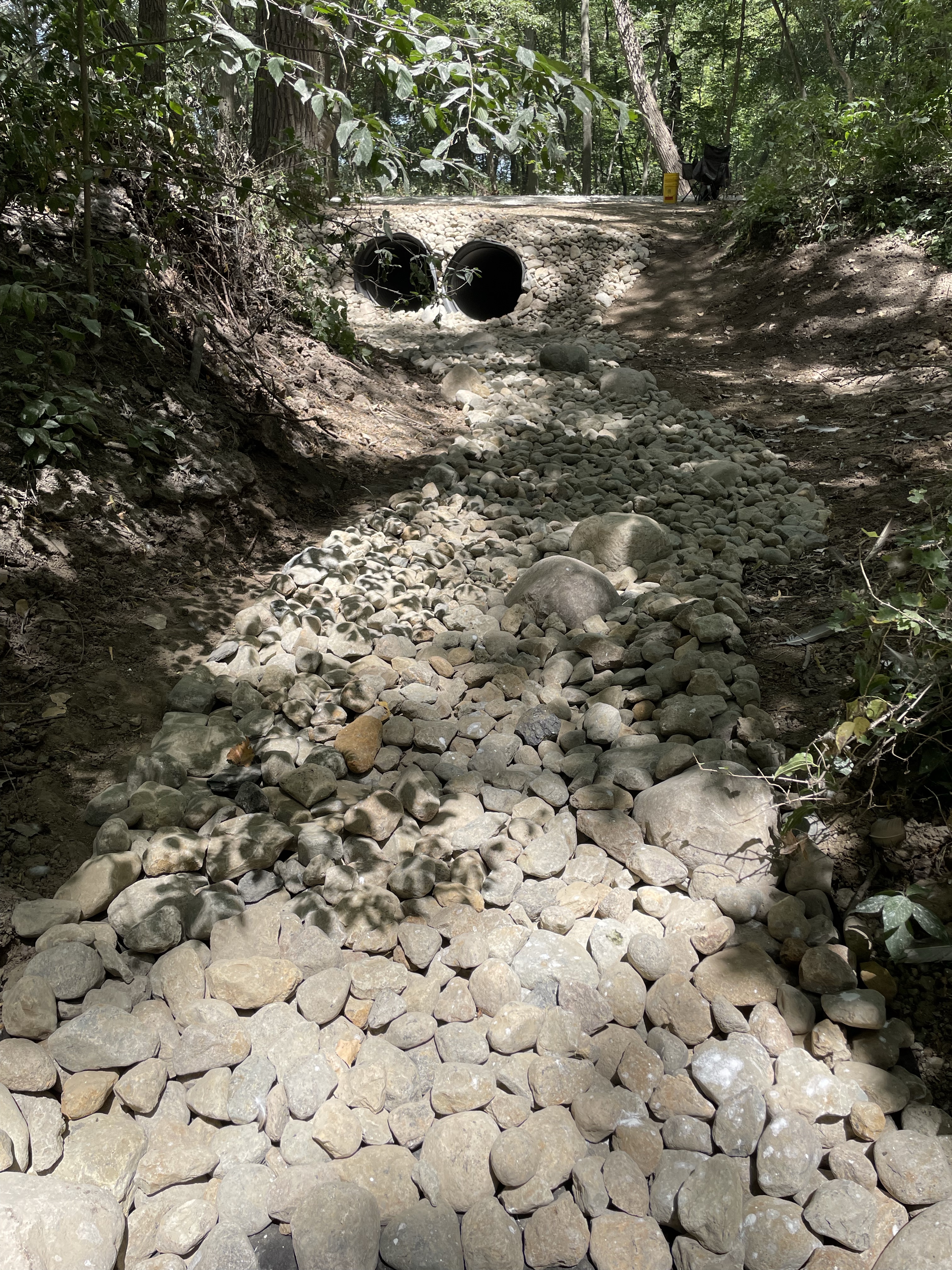
The culvert area was an issue on which we went back and forth. We knew we needed the pipes, but we weren’t sure how exactly to go about placing them and designing the surrounding landscape. One tube or two. Flared ends or no flared ends.
The culverts aren’t traditional culverts. They aren’t located in the ditch right up next to the main road. They actually lie in an existing creek bed that runs parallel to the main road, roughly fifty feet into our property.
The experts were concerned that one tube wouldn’t be enough to handle the stormwater during heavy rains, so we opted for two tubes. Flared ends are kind of like a funnel cut in half; they help guide water into the tubes and cut down on erosion as water exists the tubes. They give the tubes a more finished look and match the sloped profile of the land on both ends. The issue with the flared ends is that because of the widths of the flare, using them would require the tubes to be separated by about three feet—plus, they were backordered. The creek bed isn’t infinitely wide. Three feet diameter tube x 2, with three feet in between the tubes would require a minimum of nine feet in width. The creek just isn’t that wide, so we eventually settled on two tubes right next to each other with no flared ends.
Some of the experts wanted to dump riprap down by the ends of the pipes and call it good. We decided to do something a little bit different. The creek bed is beautiful, and we’ll cross it every time we enter and exit our property. So we embarked on a special project.


The water flows from the south to the north. Our main priority was erosion control, both around the tubes and in the creek beds. The second priority was aesthetics. We ordered some heavy duty, 8 oz non-woven landscape filter fabric with staples and several tons of gorgeous rock, varying in size from 4” to 24.”
The first order of business was to tamp down the loose dirt around the culvert pipes and clear out and shape the creek beds. We did this on a day when the heat index was over 100 degrees. It took five hours, three shovels, one trowel, a tamper, numerous breaks, and a whole lot of hydration.


Fabric day was almost a week after we cleared and cleaned the creek beds, so we gave them a quick sweep before laying out the fabric.

Next, we laid out the landscape fabric and secured it in place. We had a roll of 5’ x 300’ fabric, and a roll of 10’ x 50’ fabric. We measured, remeasured, and measured one more time. We tried to overlap all the seams by at least three feet and shingle the pieces in the direction that water flows, much like shingles on a roof. Two or more layers of fabric was so thick, we used awls to pre-punch holes for the heavy gauge staples. We used 12-inch staples on the steep slopes and 6-inch staples everywhere else.


In some areas, we didn’t staple the fabric down all the way to the edge or corner, anticipating that those areas could be trimmed or folded after the rock was placed, helping to give the creek beds a more natural shape.
Our rock was delivered the next day. We gave the fabric a quick sweep once more and got to work.

With the help of my ridiculously talented mother who happens to have experience creating dry creek beds, we began placing the rock. We started by placing the larger rocks along the edges and in areas we didn’t want the water to go in order to divert the flow toward areas we did want the water to go. Additionally, the rock slows the flow of water and lets it disperse with less energy and therefore, less erosion.


We continued placing more and more rocks, big and small, fitting them together like puzzle pieces, making sure each staple was covered by a rock and no fabric was left exposed.

We lucked out during this entire process, because we had numerous consecutive days of no precipitation and high temps. It made the work of tromping around in a creek a much less muddy endeavor. There’s no way we could have ever completed this project this quickly without the invaluable help from my in-laws, who moved actual tons and tons of rock for us.


The remaining areas of exposed dirt will be seeded with our prairie mixes this winter. Because of that, we decided to place erosion control wattles along the rock edge all the way around the creek and culvert areas. We also installed straw/coconut erosion control blankets with biodegradable stakes along the bordering embankments. We’re hoping that will help keep most of the dirt and seed from washing into the creek until the prairie has time to establish itself.


Eventually, we’d like to rock the whole creek bed along the entire length of our property. For now, we’ll use the extra fabric, staples, and rock to complete another dry creek bed along the east side of our future home site. We’ll share that project too.
**Update**
Two years after the painstaking construction of these creek beds, I caught a glimpse of them during a heavy rainstorm, and it was awesome!

Leave a Reply